Showing posts with label piety. Show all posts

Saturday, 8 October 2011

Evidences of the Divine

'But suppose I had found a watch upon the ground....'

'Two of the most influential books of the nineteenth century, still in print, were William Paley's A View of the Evidences of Christianity, of 1794, and his Natural Theology; or, Evidences of the existence and Attributes of the Deity, Collected from the Appearances of Nature, of 1802. The first question posed above could be reformulated anachronistically as an attempt to establish what Sophocles' or Pindar's "Evidences" might have looked like. In a sense there is a single, simple answer to that question, and one evidence that easily outweighs all others, even if the Greeks did not formulate the matter in quite this way. When Nicomarchus was charged in 399 with impiety for altering the traditional sacrificial calendar of Athens, the prosecutor argued: 'Our ancestors, who only made the sacrifices prescribed in Solon's code, bequeathed to us a city which was the greatest and happiest in all Greece; and so we ought to make the same sacrifices as them if for no other reason, for the good luck that they brought." In the past, when sacrifices were performed more regularly, the weather too was more regular, says Isocrates. Every dedication set up by a Greek in fulfillment of a vow is testimony that the prayer accompanying the vow has been fulfilled. The greatest evidence then for the existence of the gods is that piety works: the reward for worshipping the gods is ways hallowed by tradition is prosperity. The converse is that impiety leads to disaster; and, the piety-prosperity nexus is not often used as a proof of the existence of the gods, the afflictions of the wicked are indeed a much-cited evidence. "Father Zeus, you gods still exist on high Olympus, if the suitors have really paid the penalty for their reckless insolence", says Laertes in the Odyssey; "The gods exist," delightedly exclaims the chef in Menander's Dyskolos when his enemy, whom he regards as impious, falls down a well. We seem to catch here the tones of excited colloquial speech.

'When fair weather and flourishing crops are seen as a reward of piety, the argument rests implicitly on the assumption that the natural environment is under divine control. Here then potentially is another evidence: if every shower of rain comes from Zeus - and "Zeus" or "god" "is raining" was used more or less interchangeably in Greek with an impersonal "it is raining" - then direct contact with divine power is an everyday experience. It surely will not have felt like that, even for the pious: rain for them was rain, part of normality, as it is for us, not an epiphany. But when rain declined to fall, it could be prayed for; thunderbolts were embodiments of "Zeus who descends," storms could be caused by human pollution, winds could be summoned or averted by sacrifice, an untimely earthquake or eclipse could cause a general to be replaced, military activity to be abandoned or delayed. According to the messenger in Aeschyllus' Persai, when an unseasonable storm froze the Strymon in the face of the retreating Persian army; "people who hitherto paid no regard to the gods (θεοὺς δέ τις / τὸ πρὶν νομιζων οὐδαμοῦ)" then turned to prayers; though ascribed to Persians, the psychology is also perfectly Greek.

'This was the level at which pre-Socratic philosophy, with the premise of a rule-bound natural order, came into conflict with popular religious assumptions; and, for those educated in the philosophical schools, storms and eclipses ceased necessarily to convey any message about the divine. (But there was always the possibility of a both and / or "double determination" explanation, whereby god worked through the natural order.) Even for the less educated, such messages were only intermittently audible; this was the religion of crisis situations. Nature was a great mechanism for the transmission of communications from, and about, the divine, but the mechanism was only recognized as operating occasionally. The vaguer proposition, however, that piety is the soil in which good crops grow was a permanent if unemphatic presumption. 

Germanicus
'The "rewards of piety" argument is in principle empirical: the gods' concern for humanity is confirmed by their differential treatment of the good and the bad. The pragmatism of this approach leads to the theoretical possibility of abusing the gods when they maltreat the good just as one praises them when they punish the bad.  Complaints and even threats against unjust gods are raised by characters in literature, but there are no early Greek parallels for the popular response to the tragic early death of the Roman prince Germanicus, when temples were stoned. Perhaps our sources have censored such incidents; more probably there was a tendency in such circumstances to seek out ritual omissions and so exculpate the gods. The Rewards of Piety is in reality a pseudoempirical argument, deriving its force from selective vision, inertia, and traditionalism. Yet psychologically it doubtless remained for most Greeks the most potent of all evidences.

'Can others be found? Paley's second book, the Natural Theology is a presentation of the argument from design. It begins with a famous comparison:
In crossing a heath, suppose I pitched my foot against a stone, and were asked how the stone came to be there: I might possibly answer, that for anything I know to the contrary, it had lain there for ever: nor would it be very easy to show the absurdity of this answer. But suppose I found a watch upon the ground, and it should be inquired how the watch came to be in that place; I should hardly think of the answer which I had before given, that for anything I knew, the watch might always have been there. Yet why should not this answer serve for the watch, as well as for the stone? Why is it not as admissible in the second case as in the first? For this reason, and for no other, viz., that when we come to inspect the watch, we perceive (what we could not discover in the stone) that its several parts are framed and put together for a purpose... The inference we think inevitable, that the watch must have had a maker.
'And exactly the same reasoning applies to the universe as a whole. The ancients had no watches, but from a certain point they certainly had the argument from design: its origins are uncertain, but the phenomenon of providential design is alluded to in several passages in the late fifth century, and the reverse argument (because the world is providentially designed, therefore a provident designer exists) is fully worked out by Socrates in two passages in Xenophon's Memorabilia. Thenceforth, "intelligent design" is taken for granted by all philosophers from Plato onward except the Epicureans, who struggle hard to argue against it, and perhaps the Cynics; it forms the core of the Stoic case in Cicero's De natura deorum, where a quite close anticipation of the modern image of a "monkey on a typewriter producing the works of Shakespeare" can be found ("If an enormous number of letter were thrown on the ground, could they ever form themselves into the Annals of Ennius?) In the early mythological cosmologies, however, the world is not made, but simply happens, and though in passing allusions the gods may be said to have "made" this or that, there is no elaborated concept of a creator god. One of the central arguments of David Hume's The Natural History of Religion is that natural man is not alert to those features of the universe that seem to bespeak designedness; philosophical reflection is required to create such an awareness. The caution is certainly applicable to the Greek case. We cannot allow the argument any wide diffusion before the fourth century.'

The above paragraphs are taken from Robert Parker's excellent book On Greek Religion, Cornell, 2011, pages 2-6. Robert Parker is also the author of an earlier now classic text, Miasma, which is a study of the concept of pollution in ancient Greek religion. It seemed to me worthwhile making this lengthy quotation because it draws attention to what he sees as the fundamental drive behind the phenomena that we see as examples of piety. If you do not agree with him, you would I think be hard pressed to come up with a n alternative explanation.


Sunday, 2 October 2011

Plato and Greek Religion

An early Corthinian painting showing a sacrifice
We can't understand a dialogue like Plato's Euthyphro without some knowledge of the world in which the Greeks lived. We feel ourselves to be in some sense the intellectual heirs of the Greeks, but theirs was a world vastly different from our own and we really need to struggle to understand just how different it was in basic assumptions from the world we inhabit today. The following quotations from Michael L. Morgan's article on Plato and Greek Religion published in the Cambridge Companion to Plato provide a very helpful outline:

"Religion permeated life in classical Athens and in classical Greece generally. It is hardly surprising, then, that religious vocabulary - mention of gods, festivals, beliefs, and rites – also pervades Plato’s dialogues. These dialogues reveal a man struggling to understand human life and how it ought to be lived, a man engaged in deep reflection about rational inquiry, the human roles in society and the cosmos, and man’s relationship to the divine. Religion, as rite, conception, motif and vocabulary, is integral to his thinking. By showing how this is so we can illuminate Plato’s thinking from the religious side, as it were, and thereby exhibit Plato’s relationship to Greek religion and piety.

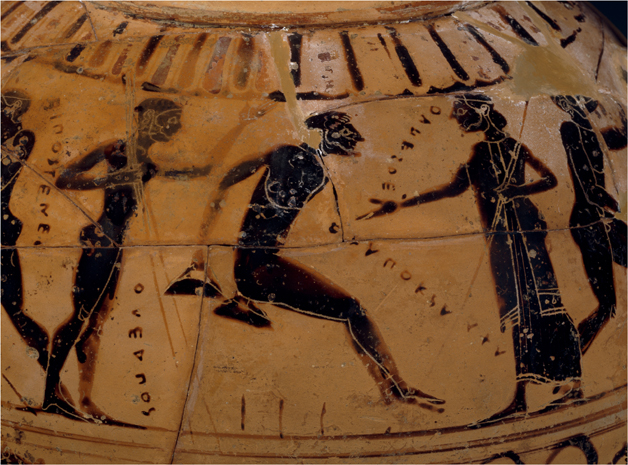
The long jump at the Olympic Games
"It is hard to exaggerate the prominence of religion in Greek life. Greek religion was pluralistic and heterogeneous; there was a host of divinities with overlapping roles and features. A dozen gods formed the conventional core of this pantheon (Zeus, Hera, Poseidon, Athena, Apollo, Artemis, Aphrodite, Hermes, Demeter, Dionysus, Hephaestus, Ares); broadly conceived as Zeus’ family, these, and lesser divinities such as the goat-footed god Pan, are the Olympians, so-called after Olympus, site of Zeus’ palace. They and other gods, such as Hades and Persephone, were themselves varied and multiple, each present at dozens of places in various guises, serving a variety of purposes and roles. Zeus, for example, manifest as a thunderbolt, was the strongest of the gods and the father of gods and men. But in fact there were many Zeuses present in many places and with many specifications – for example, “Zeus of the city”, “Zeus of the stranger”, “Zeus of boundaries”, and “Zeus of the mountain tops”. Greek polytheism, then, incorporated a plurality of gods, each with many domains and roles. At the local level, there was centralisation and continuity, for the family, the phratry [a subdivision of the tribe, of which there were originally four in Athens], the deme [the local community of which each Athenian was a citizen], and the polis. And there was some weak unity at the international level, through the celebration of certain Panhellenic festivals like the Great Panathenaea, held every four years, and the Olympic games, and through the international use of oracles, Delphi, and the sanctuaries of Zeus at Dodona and Ammon. Moreover, Homer and Hesiod were universally honoured to some degree by all Greeks..... In classical Greece everything – politics, ethics, science, painting, music, dance, drama, agriculture - had a religious character.


Herms like this one lined Athenian streets
"Each of the twelve months was filled with festivals of varying degrees of significance, from the monthly festival celebrating the new month to deme and phratry festivals and general Athenian festivals. Perhaps as many as half of the days of the Athenian year involved festivals and processions, sacrifices, dancing, hymns, and competitions. It is clear that festivals and new moons shaped the calendar and that the Greeks lived from festival to festival. Each month was named after a festival, some minor and some major. The month of Thargelion, for example, was named after the Thargelia, a celebration of Apollo that included the creation of a scapegoat [pharmakos] and the offering of a pot of boiled grain here Sacrifice was the central feature of Greek religious life. Oxen, sheep, goats and pigs were the most common victims of such acts of ritual slaughter and communal consumption, acts that were conducted constantly, some for the polis as a whole, some for the deme or the phratry, and some for the family. Gifts were continually being offered to the gods, solidarity of the community was thereby secured and the proper relationship between gods and men Oracles too were consulted for advice and counsel, and acts of divination were performed by priests, local diviners, and less dignified pedlars of prophecy. Temples, with their sacred trees and boundary stones, sacrificial altars, statues and cult images, were numerous; herms [small stone representations of Hermes placed outside Athenian homes] were everywhere. In any given year the average Athenian would participate in hundreds of religious acts and inhabit thousands of regions of religious space. In a sense, his entire world of time and space was a religious one, a complex, variegated symbiosis of land and architecture in which divinity was pervasive. His life and writings of his literary tradition expressed this sense of divine presence, of divinity that was both ubiquitously intimate and yet awesome and separate.

We need to keep two other things in mind. One is what Michael Morgan calls the Delphic theology:  "Amid all this pluralism, however, with its world of separated, powerful, and immortal deities, we can distinguish a common theological posture, one succinctly framed by the slogans associated with the Pythia, the oracle at Delphi: nothing too much, and know thyself. What these maxims meant was that human beings should recognise their limitations with respect to the gods: The gods are immortal, perfect in knowledge and exceedingly powerful; human beings are mortal and limited in power and knowledge. Human beings should not want more than they as human beings should; they should not overestimate their knowledge or capabilities, nor should they confuse who they are and who the gods are. Underlying the world of polis religion, then, was this theological attitude of separation between the divine and the human, of discontinuity, of human limits and hence of the temptation to illicit self-esteem and pride [hubris]...

Initiation into the Eleusinian mysteries
"Contrasted with this posture was the [newer, more recently introduced] attitude of those committed to the alternative religious styles that involved ecstatic rites and salvation-oriented cults. Unlike traditional Athenian piety, this attitude assumed that there was continuity between the human and the divine – for example, that both were immortal, and that the gap between them could be bridged by the divine possession of human beings [as in shamanism] or by the human attainment of the status of  divinity or by both. In short, the Orphic-Bacchic-Pythagorean-Eleusinian world assumes that relief from our physical world and its distress could be achieved by human beings becoming as completely divine as they could possibly be. There is an element in human life, the soul or psyche, that has a quasi-divine nature; it is immortal. And that element, through ecstatic ritual performance or perhaps through a life of ecstatic practice, could grow stronger and aid in the attainment of salvation."

This picture of Greek religion should help us to guard against some of the more obvious forms of misreading of the dialogue. We can now see that Euthyphro is not as some sort of weird peripheral figure - though he is himself personally weird -  but a natural and inevitable part of the Greek scene, a sort of expert on sacrifices, oaths and such matters. This picture should also help to guard against our interpreting the meeting between Socrates ad Euthyphro as some sort of confrontation between a reactionary priest and an almost-modern free-thinking liberal. It was not like that at all: Socrates shares Euthyphro’s sense of a life lived in the shadow of divine presence. What they struggle to understand and make clear is how this sense of the holy - of what it means to have a sense of the strangeness and unaccountability of the world - should shape our lives.


Friday, 30 September 2011

Plato, Euthyphro


'Euthyphro' is one of Plato's early dialogues, one that shows Socrates discussing and talking through problems in what is usually regarded as a close representation of the way the historical Socrates argued. This is probably too simple an approach to this or any other of Plato's dialogues, if only because we  are dealing with a carefully constructed work of literary art. That in itself doesn't make this a false picture of Socrates' activities but it should put us on our guard - we are not looking through a window straight onto the streets of ancient Athens. There may be other things going on here.

One indication of a literary perspective is the setting and date of the dialogue. It takes place in 399 BC, in the King Archon's court, just weeks before Socrates' trial and execution. The King Archon was one of nine chief magistrates in the city and was responsible for dealing with certain sorts of civil and religious cases. We are in other words meant to read this dialogue in the knowledge that Socrates was soon to face trial on a capital charge. Part of the interest then is the way he behaves at this moment in his life. He was at that time seventy years old and was a well-known character - Aristophanes had sent him up in one of his best-known comedies some years before, so clearly everyone knew who he was or this wouldn't have been possible - but he also had a distinguished military record, a reputation for singular toughness and endurance and, more tellingly, supposed leanings through earlier association with Alcibiades and other aristocratic elements who were believed to be deeply opposed to the newly-restored democracy. There is in other words a strong political dimension to this trial. The democrats are out for political revenge. Our dialogue takes place then under the shadow of what for its first readers would have been a known and terrible future.

The Stoa where trials for homicide and impiety were heard

Euthyphro is the name of an individual. Nobody knows if he was a real person, though he may well have been. His name is composed of two elements - euthus (εὐθύς), which means straightforward in a moral sense or direct and forthright while the second element phrōn (φρων or φρην) means heart, mind, understanding, or reason. (It is the same word we see in 'diaphragm' which was the part of the body - the muscular midriff - that was regarded in earlier Homeric days as the seat of the passions or affections). The name as a whole means right-minded or sincere and seems to be intended ironically. Euthyphro is a pretty upright kind of a fellow, not to say, as we shall see, something of a prig. He is, appropriately enough for someone with this name, an expert in religious matters, an expert in other words in anything connected with where, when and how to perform prayers and sacrifices properly. The proper performance of ritual was a matter a great importance to the ancient Greeks, not something to be taken lightly. Its the nature of the case that Euthyphro is bring that leads to the discussion recreated in Plato's dialogue. It is simply, 'What is piety?' or, as we might express this today, 'What is the nature of religious or moral obligation?'. It is clearly an important philosophical topic, something in other words, that demands discussion and clarification, as far as this is possible.


ἆρα τὸ ὅσιον ὅτι ὅσιον ἐστιν φιλεῖται ὑπὸ τῶν θεῶν,  
ἢ ὅτι φιλεῖται ὅσιόν ἐστιν;
The word that we translate as 'piety' has a complex meaning in Greek.  Its complexities should remind us that we can never simply assume that each word in their language corresponds to a word in ours; there is , in practice, always a great deal of cultural baggage that we need to be aware of if we are to avoid naive misreadings. The Greek word here is hosios (ὅσιος), which is an adjective meaning sanctioned or approved by the law of nature, as opposed to being sanctioned by human law or convention. People often spoke of things ordained by the gods and things of human ordinance. These divine things were not negotiable, as it were, but rather matters of unalterable obligation. (There is something in this that calls to mind Kant's notion of a duty-based ethics, at least in its sense that there are some things that you really have to do). In reading this dialogue we should keep in mind that hosios refers primarily to things that we really ought to do because they are demanded by the gods. 


Euthyphro's account
It is ridiculous, Socrates, for you to think that it makes any difference whether the victim is a stranger or a relative. One should only watch whether the killer acted justly or not; if he acted justly, let him go, but if not, one should prosecute, if, that is to say, the killer shares your hearth and table. The pollution (miasma) is the same if you knowingly keep company with such a man and do not cleanse yourself and him by bringing him to justice. The victim was a dependent of mine, and when we were farming in Naxos he was a servant of ours. He killed one of our household slaves in drunken anger, so my father bound him hand and foot and threw him into a ditch, then sent a man here to inquire from the priest what should be done. During the time he gave no thought or care to the bound man, as being a killer, and it was no matter if he died, which he did. Hunger and cold and his bonds caused his death before the messenger came back from the seer. Both my father and my other relatives are angry that I am prosecuting my father on behalf of a murderer when he hadn't even killed him, they say, and even if he had, the dead man does not deserve a thought, since he was a killer. For, they say, it is impious for a son to prosecute his  father for murder. But their idea of the divine attitude to piety (hosion) and impiety are wrong, Socrates. (4b-e)...

Questions:
(1) What exactly is the crime that Euthyphro's father has committed?
(2) Why does Euthyphro think that he has no choice but to prosecute his father?
(3) Is he right to think this? Would you prosecute your father in a similar situation?
(4) Is there any clear way to resolve the conflict of opinion between Euthyphro on the one hand and his father and his relatives on the other?
(5) What knowledge does Euthyphro implicitly claim (in the last sentence) that he has and that others do not have? 

Socrates talks about the idea that lies in or behind appearances 
... So tell me now, by Zeus, what you just now maintained you clearly knew: what kind of thing do you say that godliness and ungodliness are, both as regards murder and other things; or is the pious not the same and alike in every action, and the impious the opposite of all that is pious and like itself, and everything that is to be impious presents us with one form (idea or eidos) or appearance insofar as it is impious? (5c-d)
Questions:
(1) What is Socrates saying here?
(2) What assumption lies behind this assertion?


The Key Question:
The key question in this dialogue is this one where at 10a Socrates asks what it is that makes what is holy holy? Is what is holy loved by the gods because it is holy or is it holy because it is loved? This is an alternative translation for to hosion which is perhaps better here. Does what is holy derive its character as something holy from the fact that the gods have declared it to be holy or do they love what is sacred because it is intrinsically good and demanding of our attention and compliance? Socrates wants us to come to this second conclusion. He wants us to to arrive by a process of close logical argument at a recognition of the independence of what he calls piety or holiness. The Greek text uses the word eidos, which means form or shape. We can see here in this early dialogue the first shaping of the theory that Plato later attributed to Socrates and which we know as the Theory of Forms. Plato imagines the things that give direction and significance to our lives, things like courage, piety, good judgement and the like as existing independently of humanity in some undefined place of ultimate values, a sort of values-heaven, a place where you would find the Forms of courage and piety and such mathematical entities as √2 and π, but in Euthyphro we are not so far along that line of development. One thing we probably can say is that Socrates did not himself create or share this theory, although Plato might reply that it is implicit in the sort of things that Socrates said.
      
The Socratic elenchus
This key question is the heart of Socrates' method, what is usually called the Socratic elenchus. This word elenchus or in Greek ἔλεγχος, means simply a cross-examination or scrutiny for the purposes of refutation. (The elenchus works by showing that some belief is incompatible with another and that therefore one of the two must be abandoned; ultimately, however, the elenchus does not and cannot demonstrate that some one position is the right and true one - that choice must be left to the participant. Notice that the elenchus rests on an assumption that all our beliefs should be consistent with one another and that reason will lead us all toward an identical conclusion). 

The interest here is in the logical argument that Socrates constructs, perhaps a little cruelly at Euthyphro's expense. We should, however, keep in mind Plato's larger literary objective, for it is part of Plato's purpose to show that it is Socrates who is - contrary to the claims of Meletos and his other his prosecutors - the man who genuinely cares about to hosion. We see him at the start of the dialogue that he is genuinely surprised at Euthyphro's lawsuit, and as the exchange continues we see that it is Socrates and not Euthyphro or the mass of his fellow-citizens who has thought long and hard about the nature of man's relation to the gods and what this ought to be.
Wittgenstein releasing flies

This is the literary background for the Socratic elenchus. Euthyphro claims that he has precise knowledge about piety and impiety (4e4-5a2). Socrates takes Euthyphro at his word and proceeds by putting a series of questions to him that seem on the surface at least designed to obtain a clear statement of what Euthyphro believes piety to be. The argument proceeds by taking Euthyphro's replies one at a time with Socrates always taking care to secure agreement to his formulations before going further. The investigation looks like a cooperative venture and the final result is the mutually agreed outcome of all the steps which have preceded it. But from our point of view as readers we ca see that Socrates is leading Euthyphro into a logical trap, even if we cannot foresee exactly what shape this will take. he does this by securing agreement to statements which turn out to contradict one another. The argument continues until at least one of the statements is abandoned, usually by mutual agreement. The state of intellectual perplexity caused by the realisation that the argument has led to an untenable contradiction is called aporia or ἀπορία, a word which means that one is perplexed, at one's wits' end, not knowing how to proceed. This dialogue does not resolve our bewilderment. We are left in this state of aporia. You might recall as a kind of distant parallel Wittgenstein's reply when asked what was his aim in philosophy - To show the fly the way out of the bottle! In a sense this is Socrates' aim too.

Socrates' aim, however, goes beyond the resolution of logical difficulties for what he wants is a correct understanding that would put him closer to the right relationship to the gods. For him that relationship must be a matter of discovering the objectively right relationship for it cannot in any sense in the terms of his approach to the argument be a matter of individual choice or election. He is as Plato depicts him in this dialogue and elsewhere someone whose investigations always proceed on the basis of his claim that he knows nothing. To some degree this seems an ironical stance, but it is not insincere; he does claim or is represented as  claiming that any knowledge he has is a matter of accident. he may have thought about things but he doesn't claim that he actually knows. He is like the man who staggers out of the cave towards the light. He is on the way towards the sun, but he has not yet reached that intellectual world of perfect knowledge. he is in Plato's terminology a philosophos - a lover of wisdom - and not a philotheamōn - a lover of sights, shows and distractions. Our pilgrimage is it seems for Plato either up towards or away from the light.  There is no standing still.

Questions:
(1) What is meant by to hosion and piety?
(2)  Can you follow the steps of Socrates' argument? What is the implication of his conclusion about to hosion?
(3)  Would it be reasonable to see in Socrates' and Plato's approach the influence of ecstatic religious cults that seek to transcend the human condition? Or is Socrates simply a run-of-the-mill adherent of traditional polis religion?
(4) Can there be a single objective set of values  separate from anything we might want or choose? Is this view really implicit in this dialogue?
(5) Is this dialogue the creator of Socrates's character or is the dialogue ultimately his creation?  
(6) Is philosophy an entirely theoretical discipline or should it be concerned with personal transformation?


Search This Blog