|
| An early Corthinian painting showing a sacrifice |
We can't understand a dialogue like Plato's Euthyphro without some knowledge of the world in which the Greeks lived. We feel ourselves to be in some sense the intellectual heirs of the Greeks, but theirs was a world vastly different from our own and we really need to struggle to understand just how different it was in basic assumptions from the world we inhabit today. The following quotations from Michael L. Morgan's article on Plato and Greek Religion published in the Cambridge Companion to Plato provide a very helpful outline:
"Religion permeated life in classical Athens and in classical Greece generally. It is hardly surprising, then, that religious vocabulary - mention of gods, festivals, beliefs, and rites – also pervades Plato’s dialogues. These dialogues reveal a man struggling to understand human life and how it ought to be lived, a man engaged in deep reflection about rational inquiry, the human roles in society and the cosmos, and man’s relationship to the divine. Religion, as rite, conception, motif and vocabulary, is integral to his thinking. By showing how this is so we can illuminate Plato’s thinking from the religious side, as it were, and thereby exhibit Plato’s relationship to Greek religion and piety.
 |
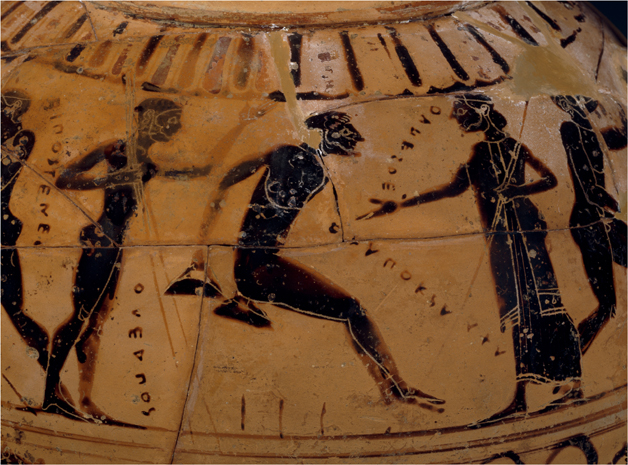
| The long jump at the Olympic Games |
"It is hard to exaggerate the prominence of religion in Greek life. Greek religion was pluralistic and heterogeneous; there was a host of divinities with overlapping roles and features. A dozen gods formed the conventional core of this pantheon (Zeus, Hera, Poseidon, Athena, Apollo, Artemis, Aphrodite, Hermes, Demeter, Dionysus, Hephaestus, Ares); broadly conceived as Zeus’ family, these, and lesser divinities such as the goat-footed god Pan, are the Olympians, so-called after Olympus, site of Zeus’ palace. They and other gods, such as Hades and Persephone, were themselves varied and multiple, each present at dozens of places in various guises, serving a variety of purposes and roles. Zeus, for example, manifest as a thunderbolt, was the strongest of the gods and the father of gods and men. But in fact there were many Zeuses present in many places and with many specifications – for example, “Zeus of the city”, “Zeus of the stranger”, “Zeus of boundaries”, and “Zeus of the mountain tops”. Greek polytheism, then, incorporated a plurality of gods, each with many domains and roles. At the local level, there was centralisation and continuity, for the family, the phratry [a subdivision of the tribe, of which there were originally four in Athens], the deme [the local community of which each Athenian was a citizen], and the polis. And there was some weak unity at the international level, through the celebration of certain Panhellenic festivals like the Great Panathenaea, held every four years, and the Olympic games, and through the international use of oracles, Delphi, and the sanctuaries of Zeus at Dodona and Ammon. Moreover, Homer and Hesiod were universally honoured to some degree by all Greeks..... In classical Greece everything – politics, ethics, science, painting, music, dance, drama, agriculture - had a religious character.
 |
| Herms like this one lined Athenian streets |
"Each of the twelve months was filled with festivals of varying degrees of significance, from the monthly festival celebrating the new month to deme and phratry festivals and general Athenian festivals. Perhaps as many as half of the days of the Athenian year involved festivals and processions, sacrifices, dancing, hymns, and competitions. It is clear that festivals and new moons shaped the calendar and that the Greeks lived from festival to festival. Each month was named after a festival, some minor and some major. The month of Thargelion, for example, was named after the Thargelia, a celebration of Apollo that included the creation of a scapegoat [pharmakos] and the offering of a pot of boiled grain here Sacrifice was the central feature of Greek religious life. Oxen, sheep, goats and pigs were the most common victims of such acts of ritual slaughter and communal consumption, acts that were conducted constantly, some for the polis as a whole, some for the deme or the phratry, and some for the family. Gifts were continually being offered to the gods, solidarity of the community was thereby secured and the proper relationship between gods and men Oracles too were consulted for advice and counsel, and acts of divination were performed by priests, local diviners, and less dignified pedlars of prophecy. Temples, with their sacred trees and boundary stones, sacrificial altars, statues and cult images, were numerous; herms [small stone representations of Hermes placed outside Athenian homes] were everywhere. In any given year the average Athenian would participate in hundreds of religious acts and inhabit thousands of regions of religious space. In a sense, his entire world of time and space was a religious one, a complex, variegated symbiosis of land and architecture in which divinity was pervasive. His life and writings of his literary tradition expressed this sense of divine presence, of divinity that was both ubiquitously intimate and yet awesome and separate.
We need to keep two other things in mind. One is what Michael Morgan calls the Delphic theology: "Amid all this pluralism, however, with its world of separated, powerful, and immortal deities, we can distinguish a common theological posture, one succinctly framed by the slogans associated with the Pythia, the oracle at Delphi: nothing too much, and know thyself. What these maxims meant was that human beings should recognise their limitations with respect to the gods: The gods are immortal, perfect in knowledge and exceedingly powerful; human beings are mortal and limited in power and knowledge. Human beings should not want more than they as human beings should; they should not overestimate their knowledge or capabilities, nor should they confuse who they are and who the gods are. Underlying the world of polis religion, then, was this theological attitude of separation between the divine and the human, of discontinuity, of human limits and hence of the temptation to illicit self-esteem and pride [hubris]...
 |
| Initiation into the Eleusinian mysteries |
"Contrasted with this posture was the [newer, more recently introduced] attitude of those committed to the alternative religious styles that involved ecstatic rites and salvation-oriented cults. Unlike traditional Athenian piety, this attitude assumed that there was continuity between the human and the divine – for example, that both were immortal, and that the gap between them could be bridged by the divine possession of human beings [as in shamanism] or by the human attainment of the status of divinity or by both. In short, the Orphic-Bacchic-Pythagorean-Eleusinian world assumes that relief from our physical world and its distress could be achieved by human beings becoming as completely divine as they could possibly be. There is an element in human life, the soul or psyche, that has a quasi-divine nature; it is immortal. And that element, through ecstatic ritual performance or perhaps through a life of ecstatic practice, could grow stronger and aid in the attainment of salvation."

This picture of Greek religion should help us to guard against some of the more obvious forms of misreading of the dialogue. We can now see that Euthyphro is not as some sort of weird peripheral figure - though he is himself personally weird - but a natural and inevitable part of the Greek scene, a sort of expert on sacrifices, oaths and such matters. This picture should also help to guard against our interpreting the meeting between Socrates ad Euthyphro as some sort of confrontation between a reactionary priest and an almost-modern free-thinking liberal. It was not like that at all: Socrates shares Euthyphro’s sense of a life lived in the shadow of divine presence. What they struggle to understand and make clear is how this sense of the holy - of what it means to have a sense of the strangeness and unaccountability of the world - should shape our lives.